
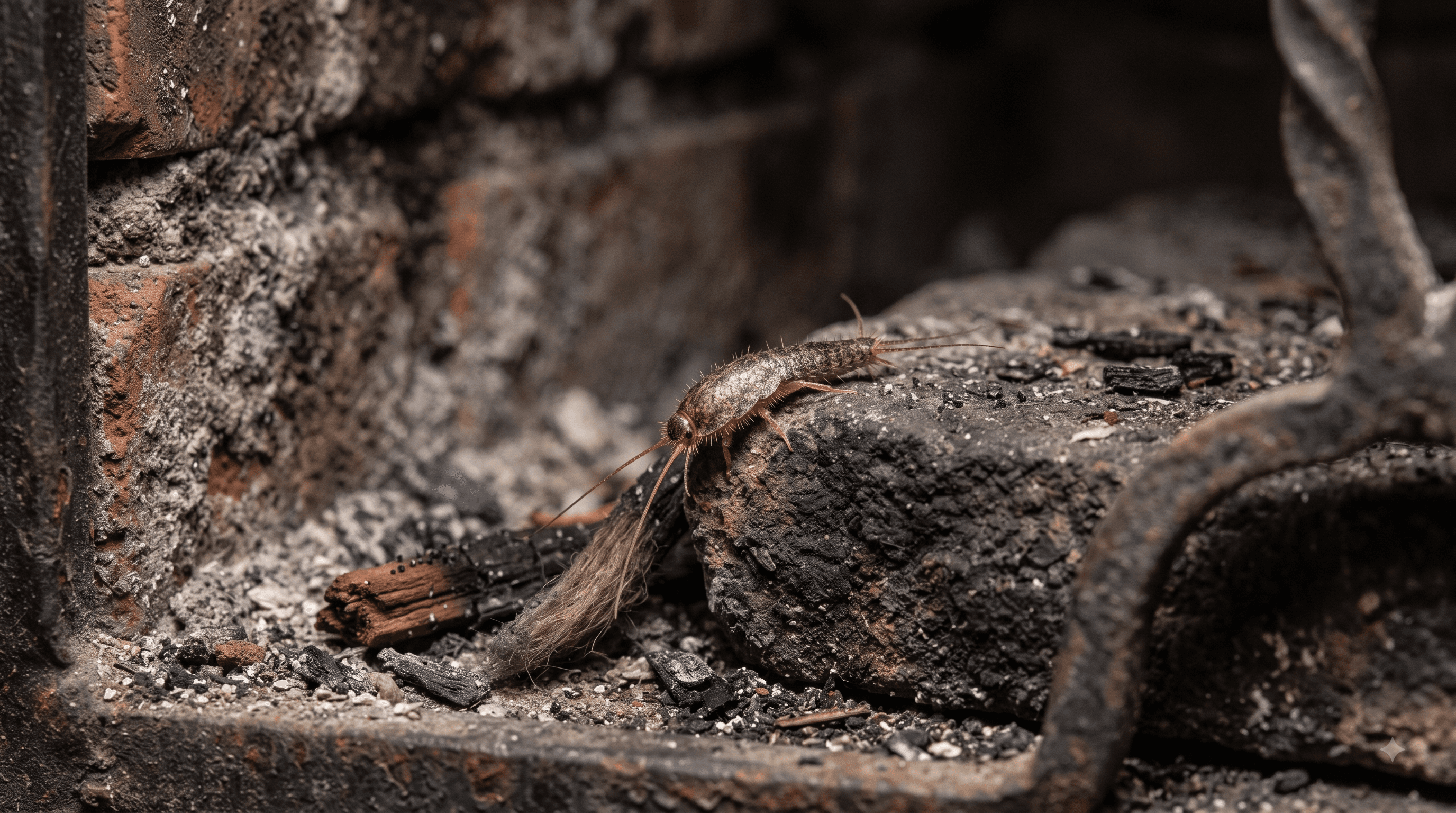
Where Does a Firebrat Live?
Firebrats live in warm, humid, dark places such as furnaces, boilers, fireplaces, and attics. Learn where firebrats hide in a house and outdoors.
Global Pest Library Research Team
Global Pest Library
Firebrats live in warm, humid, dark places where they can find shelter, moisture, and food. Inside homes, they are most commonly found near furnaces, boilers, ovens, fireplaces, water heaters, and hot-water pipes. Outdoors, firebrats can live under rocks, bark, leaf litter, and other sheltered areas where warmth and moisture are available.
Unlike silverfish, which generally prefer cooler damp areas, firebrats are strongly associated with higher temperatures. In buildings, they are particularly likely to occupy areas that stay warm for long periods.
Where Do Firebrats Live Indoors?
Firebrats are especially common in warm, damp areas of buildings. They can hide in cracks, wall voids, insulation, and other protected spaces during the day and become active at night.
Common indoor locations include:
- Around furnaces and boilers
- Near ovens and fireplaces
- Around water heaters
- Along hot-water and heating pipes
- Inside warm utility rooms
- Around heating vents
- In attic spaces, particularly during warm weather
- Inside wall voids and insulation
- Behind baseboards and other concealed areas
Firebrats are not restricted to one particular room. If a home has suitable temperature and humidity conditions, they can move through cracks, gaps, and wall or floor openings to reach other areas.
Where Do Firebrats Live in a House?
The location of the heat source often provides the biggest clue.
If you are finding firebrats around a furnace, boiler, water heater, oven, fireplace, or hot pipe, the surrounding area may be providing the temperature they need.
They can also hide in places that are not immediately next to a heat source. Firebrats are nocturnal and can travel through concealed spaces at night in search of food and suitable conditions.
For example, a firebrat found in a bathroom does not necessarily mean the bathroom is where it lives. It may have moved there from a warmer hiding place or fallen into a bathtub or sink while searching for moisture or food.
Do Firebrats Live in Attics?
Yes. Attics can provide suitable conditions for firebrats, particularly during hot weather.
An attic can become considerably warmer than the rest of a house, while insulation and other materials can provide sheltered places to hide. Extension sources specifically identify attics as locations where firebrats may occur, particularly when temperatures are high.
If firebrats are repeatedly appearing in an attic, look beyond the insects themselves. Stored cardboard, paper, insulation, humidity, and other sheltered materials can provide favorable habitat.
Do Firebrats Live in Basements?
They can, but a basement is generally more characteristic of silverfish than firebrats.
Firebrats prefer substantially warmer conditions, while silverfish are more commonly associated with cooler, damp basements. However, a basement containing a furnace, boiler, water heater, or heated pipes can provide the warm environment firebrats prefer.
Therefore, finding a silverfish-like insect in a basement does not automatically mean it is a silverfish. Consider both the insect's appearance and the temperature of the area where it was found.
Do Firebrats Live in Bathrooms?
Firebrats can be found in bathrooms, especially when the room is warm and humid or when a nearby heat source provides suitable conditions.
However, bathrooms are more commonly associated with silverfish because silverfish favor cooler, damp environments. Firebrats are more likely when the bathroom or an adjacent wall contains hot-water pipes or another warm area.
A firebrat can also end up trapped in a bathtub or sink. These insects are fast runners but may be unable to climb the smooth sides after falling inside.
Where Do Firebrats Live Outdoors?
Firebrats are not exclusively indoor insects. They can live outdoors in warm, sheltered locations where moisture and organic material are available.
Outdoor habitats can include:
- Under rocks
- Beneath tree bark
- In leaf litter
- Around sheltered organic material
- In bird or mammal nests
- In some ant or termite nests
- Other protected locations where warmth and moisture are present
Outdoor firebrats are usually difficult to notice because they avoid light and spend much of their time hidden.
This also means that finding a firebrat inside does not necessarily mean it developed inside the house. Firebrats can enter buildings through openings and then find favorable conditions around heat sources and other sheltered areas.
What Temperature Do Firebrats Prefer?
Temperature is one of the most useful clues when determining whether you are dealing with a firebrat.
Firebrats generally prefer very warm conditions, with extension sources commonly describing preferred temperatures around 86–90°F (30–32°C) or higher. Some sources report an optimum around 98–102°F (37–39°C).
They also require access to humidity or moisture, although their temperature preference distinguishes them from typical silverfish.
In simple terms:
- Silverfish: cooler + damp
- Firebrats: very warm + humid
That difference can be extremely useful when trying to identify where the insect is coming from.
Where Do Firebrats Hide During the Day?
Firebrats are primarily nocturnal. During daylight hours, they can remain hidden in cracks, crevices, wall voids, insulation, behind baseboards, and other protected spaces. They emerge at night to search for food and suitable conditions.
This is one reason you may occasionally see a firebrat running across a floor but have difficulty finding where it came from.
If you repeatedly see them in the same area, inspect the surrounding walls, pipes, heating equipment, stored materials, and other concealed spaces rather than only looking at the exact location where the insect was spotted.
Why Are Firebrats Living in My House?
If firebrats are repeatedly appearing indoors, your home may contain a combination of heat, humidity, food, and protected hiding places that suits them.
Common conditions include:
- Hot pipes or heating equipment
- Warm, humid utility areas
- Attic heat
- Cracks and wall voids
- Insulation
- Stored cardboard and paper
- Food particles or other organic material
- Openings that allow insects to enter from outside
The presence of firebrats does not necessarily indicate an unclean home. Their habitat preferences are strongly influenced by temperature, moisture, and shelter.
Do Firebrats Live in the Same Places as Silverfish?
Not usually.
Although the two insects look very similar, their preferred habitats are different. Silverfish generally favor cooler, damp areas such as basements, bathrooms, laundry rooms, and areas around plumbing. Firebrats prefer much warmer locations, particularly around furnaces, ovens, boilers, fireplaces, hot-water pipes, and hot attic spaces.
If you are unsure which insect you have, where you found it can be an important identification clue.
How Do You Find Where Firebrats Are Living?
Start with the areas where you see them most often. Then work backward toward the nearest source of heat and moisture.
Check around furnaces, boilers, water heaters, hot pipes, fireplaces, ovens, attic insulation, wall voids, and cracks or gaps around heated areas.
Because firebrats are nocturnal, inspecting the area after dark can sometimes provide more useful information than searching during the day.
If you repeatedly find firebrats throughout the home, identifying the conditions that are supporting them is more useful than simply dealing with the individual insects you see.
For a complete overview of firebrats, including what they look like, what they eat, how they behave, signs of an infestation, and how to control them, see our complete firebrat pest guide.
Frequently Asked Questions
Where do firebrats live?
Do firebrats live in attics?
Do firebrats live in basements?
Where do firebrats live outdoors?
What temperature do firebrats prefer?
Explore Pest Identification Guides
Global Pest Library provides independent, evidence-based research articles to help you identify household pests and understand safety protocols.
Explore Our Pest Library
Identify household pests and learn about evidence-based prevention options.
Bed Bugs
Comprehensive research and multi-lingual guidance for identifying, preventing, and preparing for bed bug eradication.
Learn more →
Ants
From pavement ants to carpenter ants, identify ant species and locate nests at their source.
Learn more →
Cockroaches
Identify cockroach species and understand gel baits, IGRs, and sanitation protocols.
Learn more →
Mosquitoes
Larval source reduction and barrier treatment strategies to protect outdoor areas.
Learn more →